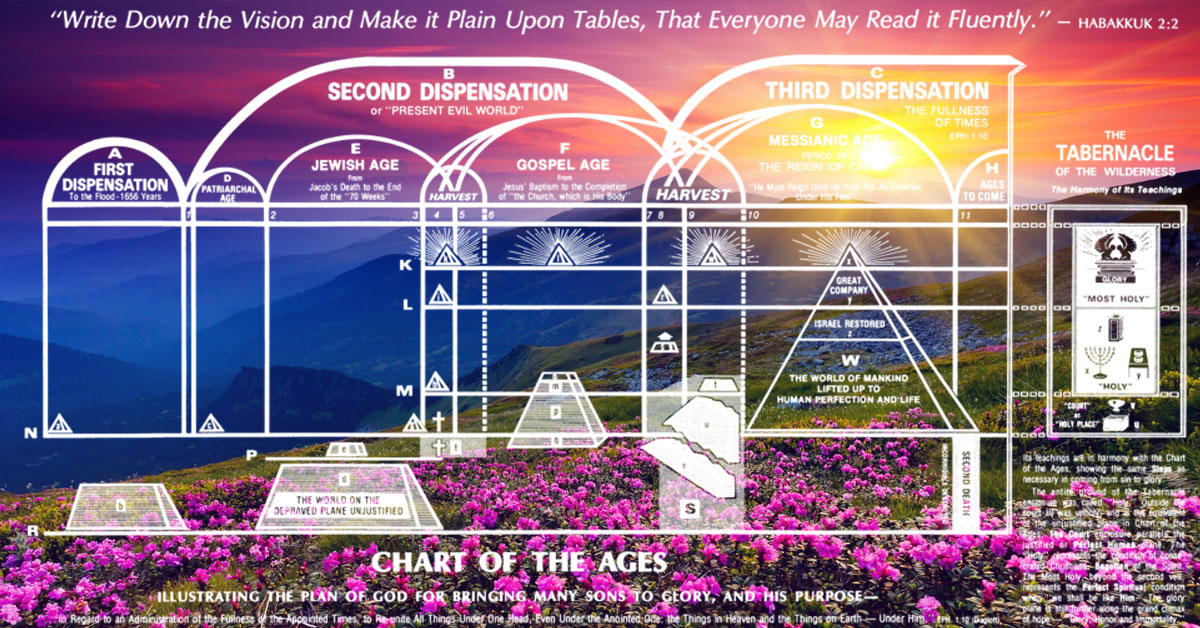
There are many reasons biblical genealogy is important. First, why does anyone study genealogy? It gives the family history. In the case of the Bible, it records the history of mankind. Who were our first parents? How long ago did they live? What experiences did they have? Who were their children? God “has made of one blood all nations of men to dwell on all the face of the earth” (Acts 17:26). In Genesis 5, we get a connected history of the first 1656 years of human history through genealogy.
As a side point, science has confirmed we all came from the same mother. The mitochondria DNA in the cell is only passed down from mother to daughter and all women have the same mitochondrial DNA. The science community calls this female ancestor “mitochondrial Eve.” DNA-sequencing of the human Y-gene which is passed down only from father to son also points to one common ancestor for men also. The science community calls this male ancestor “Y-gene Adam.”
Secondly, we can trace the faith line of Mary and Joseph and see that Jesus is the promised Messiah. Luke 3:23-38 records the genealogy of over 4,000 years from Jesus to Adam. God honored Abraham as the father of the faithful, and he was told through his posterity all the families of the earth would be blessed (Genesis 22:17-18). The faith line of the Messiah was narrowed down to the tribe of Judah (Genesis 49:9, 10). Several centuries later the faith line was narrowed down to a family. David was promised that the Messiah would be one of his descendants. (1 Chronicles 17:11-14) That’s why Jews kept an accurate family history.
Both Mary and Joseph were descendants of David. They were traveling to Bethlehem to register for taxes. “And Joseph also went up from Galilee out of the city of Nazareth into Judea unto the city of David which is called Bethlehem; because he was of the house and lineage of David” (Luke 2:4) Before Jesus’ conception Mary was told, “He shall be great and shall be called the Son of the Highest and the Lord God shall give unto him the throne of his father David.” (Luke 1:32) David was one of Jesus’ ancestors.
God keeps his promises. The promises made to Abraham, Judah and David are fulfilled in Jesus, the world’s redeemer. In verse 33, the angel gave Mary another promise about her baby. It was “he shall reign over the house of Jacob forever and of his kingdom there shall be no end.” We are yet waiting for its fulfillment.
Additional Resource:
Christian Questions Podcast
Episode #1312: “How Do We Know Jesus Is the Promised Messiah? (Part I)”
Jewish skepticism and key Old Testament identifiers of the Messiah
Preview Video
CQ Rewind Show Notes
Related Questions
July 31st 2014 | 40254 views Where does the Bible say Jesus was 40 days old when he was presented in consecration to the heavenly Father by his parents? Is this the basis for the custom observed by some in presenting their children to the Lord?
August 01st 2014 | 40199 views I find in Matthew and Luke what purport to be the genealogies of Christ. Matthew gives his ancestry back to Abraham; Luke goes back to Adam. Between Christ and David, Matthew gives 27 generations, and Luke gives 42; and none of the names in these two lists are the same. Will you please explain this seeming genealogy discrepancy?
July 31st 2014 | 40307 views Who wrote the book of Kings, and what was its purpose?
July 08th 2017 | 47469 views What is meant by the "Judgment Day" and when will it be? Is it to be a 24 hour day?
July 31st 2014 | 40100 views Historically, is there a ten year gap between the 69th. and 70th. prophetic weeks of Daniel 9:24-27? Is a gap the reason why some believe 7 years of tribulation are separated from the earlier 69 prophetic weeks?
November 18th 2017 | 40761 views Why was Daniel given the vision in Daniel 9:24-27? (2300 days, 70 weeks)
February 13th 2016 | 40498 views How many years are from Genesis to Revelation?
September 26th 2014 | 48951 views