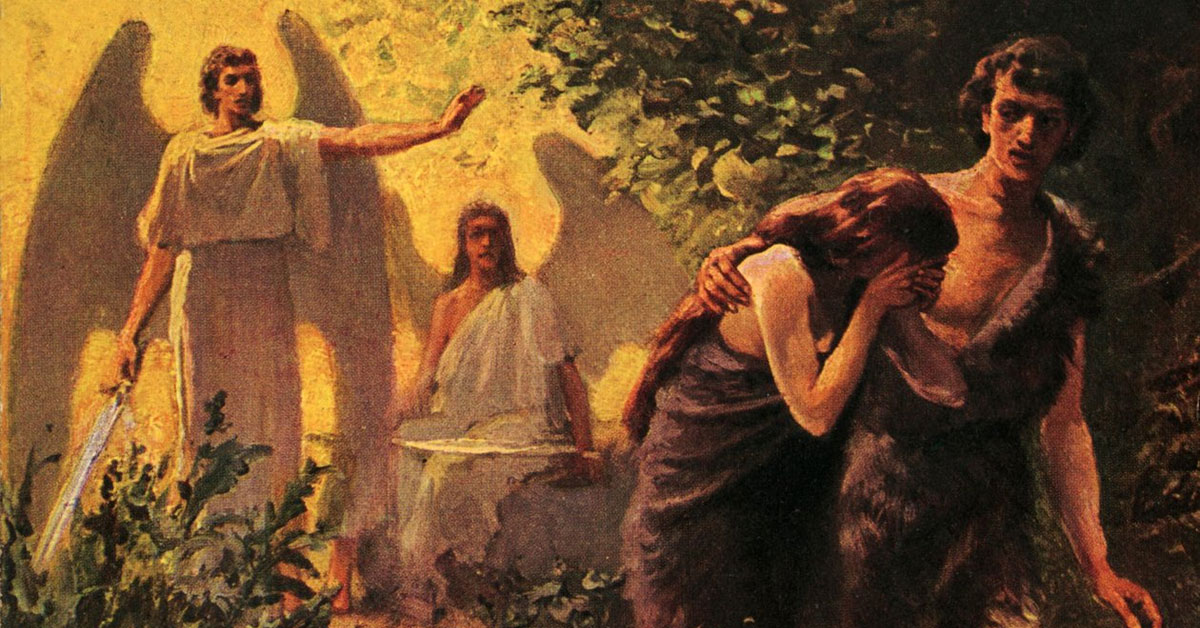
hen Adam and Eve lived in the Garden of Eden, everything beyond its borders was still unfinished — a vast, undeveloped earth. It wasn’t evil or chaotic; it was simply not yet shaped into the kind of home God intended humanity to eventually cultivate.
God shaped the world for human life, the earth was “without form and void” (Genesis 1:2), and only a specific area—Eden—was planted and fully prepared by the Lord as a finished home for Adam and Eve (Genesis 2:8). Outside that garden, the ground had not yet been subdued, which is why God commanded humanity to “fill the earth and subdue it” (Genesis 1:28). After the fall, this larger, undeveloped world is described as producing “thorns and thistles” (Genesis 3:17–18), in contrast to the cultivated perfection of Eden. Taken together, these passages imply that Eden was the only completed, ordered environment, while the rest of the earth remained in its original, unfinished condition—awaiting humanity’s future work of development and stewardship.
The rest of the earth wasn't “bad”; it was simply incomplete. It wasn’t cursed in a moral sense — it was just not yet subdued or arranged for effortless human life. Only Eden had been intentionally shaped and ordered by God as a ready-made dwelling place.
Humanity was meant to grow, spread out, and gradually bring the entire earth up to Eden’s standard. “Fill the earth and subdue it” was a long-term command. God knew the fall would happen. The unprepared earth would become the environment where the consequences of sin — toil, struggle, and hardship — would teach the human family deep lessons over thousands of years. However, even in its unfinished state, the earth was loaded with resources — minerals, coal, and other materials that would eventually support human development and civilization.
Related Questions
January 09th 2018 | 40168 views Why was death a just penalty for Adam? Was Adam under a law?
May 26th 2020 | 105293 views Were there other people outside of the Garden of Eden while Adam and Eve were in the garden?
August 30th 2017 | 44951 views The Bible said in Genesis 1 verse 3, "and God said let there be light ." Who was God speaking to? Was it Jesus?
April 02nd 2019 | 41184 views How can we reconcile Ecclesiastes 1:4, which says the earth “abides forever,” with scientific claims that the solar system is slowly running down and that the earth may one day become cold and lifeless?
July 30th 2014 | 40335 views In Genesis 1:2, the earth was without form and void; and darkness was upon the face of the deep and the Spirit of God moved upon the face of the waters. The linking verb "was" has several different meanings. So is it possible that Genesis 1:2 is saying that the earth "became" without form and void? Can you replace "was" with another linking verb?
July 15th 2020 | 106922 views Why is the visible bump on the neck called an Adam's Apple?
August 24th 2014 | 41994 views God is the Creator of everything, so why did He create Lucifer? Even though Lucifer was created to worship God, didn't God know Lucifer would turn against Him?
September 26th 2015 | 41243 views