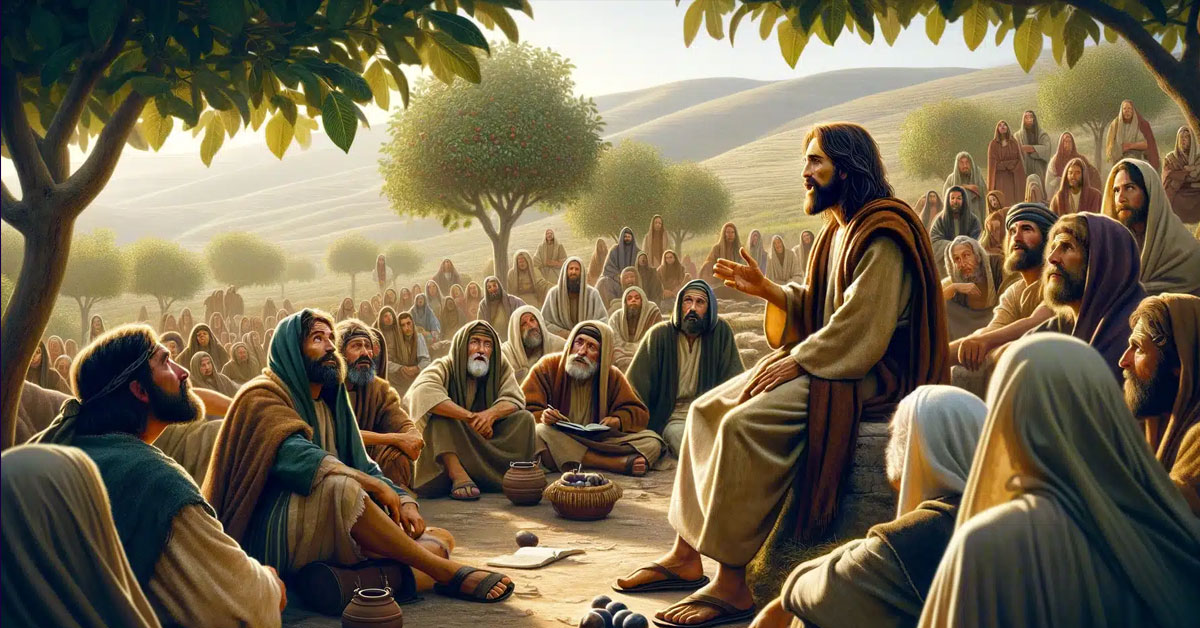
There is not a single word in this parable about the Rich Man being a wicked man or the Poor Man being a good man. Therefore, it could be positively stated that there is nothing said about the wicked going to eternal torment at death. To interpret the story literally, as many who believe in the theory of eternal torment for the majority of mankind, creates a number of absurdities. It would teach that all who have expensive purple and fine linen clothing, and who feast on rich food every day, will, at death, go into a furnace of fire and be tormented. It would also mean that unless we were poor beggars, the companion of dogs, full of sores, and feed on crumbs at some rich man's back gate, we would never be able to wing our flight to Abraham's bosom. Poor Abraham would experience considerable difficulty in clasping all the poor to his expanding bosom! The parable, rightly understood, never teaches the monstrous doctrine of eternal torment.
The Scriptures were written in such a way, that they could not be understood except by those who would come into harmony with God by faith and obedience. The Lord is pleased to enlighten His children by the operation of the holy spirit to His Divine purposes. Our Lord Jesus addressed the multitudes in parables and dark sayings and then afterwards explained them to His disciples. (`Mark 4:11,33,34`) The parable of "The Rich Man and the Poor Man" is a remarkable prophecy of conditions relating to the Jews and the Gentiles. We believe, could have been stated in no other way without disclosing the realities which was evidently Jesus intended the understanding of this parable to remain concealed from the world, but its real significance would be made known only to His devoted followers. The entire book of Revelation is composed of prophecies thus concealed in signs, symbols and figures.
To explain the parable, "Lazarus" symbolizes Gentiles, while the rich man represents the Jewish people. The Jews were "rich" living under God's protective Covenant, having God's laws, and receiving God's blessings.
After Jesus's first advent in 70 AD, the two prominent Jewish tribes of Judah and Benjamin (the other ten were scattered across the Gentile nations) were sought out and killed by Rome. The Jews lost their right to live in Jerusalem and lost God's protection. Why? Because the Jews accepted responsibility for Jesus's crucifixion when they said, "His blood is upon us, and upon our children!" (Matthew 27:25) Thus began 1845 years of punishment and the loss of God's favor.
Over those centuries, the Jews were persecuted, hunted and executed, could not own land, etc. It was a terrible period - so the parable identifies this time as being "in torment in hell." The hell aspect refers to the death of their nation.
During this same period, Lazarus, the Gentile nations outside of a covenant relationship with God, learned of the Gospel and the heavenly calling through Jesus. Those who responded to the call became Abraham's seed of promise (symbolized as being taken to Abraham's bosom).
Related Questions
July 31st 2014 | 40224 views When I die it has been said that someone can pray me into heaven. Is that true?
April 14th 2015 | 42109 views What happens to us the minute we die. Where do we go?
February 24th 2017 | 40842 views Since the Apostle clearly explains in 1 Corinthians 15:35-38, that the body will not be resurrected, what does he mean when he says: "So also is the resurrection of the dead. It is sown in corruption, it is raised in incorruption," etc. (1 Corinthians 15:42-44) What is meant by the expression, "it"? What is resurrected?
August 01st 2014 | 39902 views Please show me in the Bible where the Old Testament saints were before the resurrection of Christ? What is the place called? What is the difference between Sheol, Hades, and Hell.
May 12th 2017 | 40828 views Why is Jesus called the first born from the dead?
September 14th 2018 | 40154 views What does the Bible teach about where we go when we die? Do our souls sleep in the grave? In the resurrection, will everyone be resurrected with earthly bodies and live on earth?
March 16th 2018 | 40662 views 1 Samuel 28:14-19 records a medium bringing the spirit of the dead prophet Samuel to talk to King Saul. How can this happen? Are dead ancestors alive and watching us?
February 07th 2020 | 104715 views