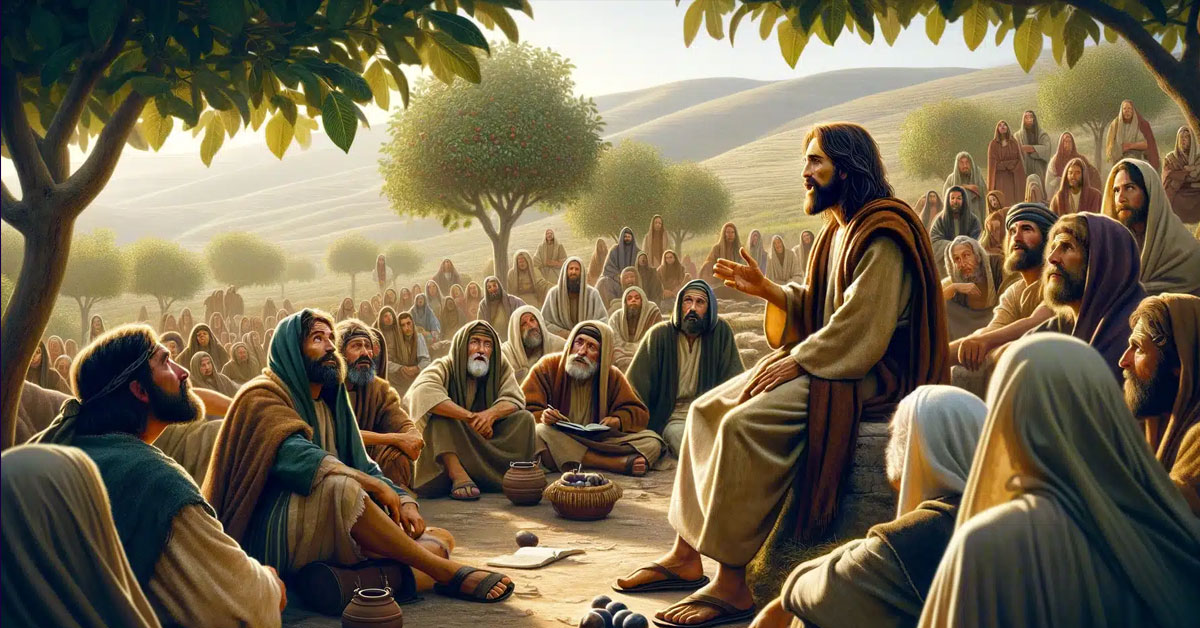
Luke 14:7-11 "And he put forth a parable to those which were bidden, when he marked how theychose out the chief rooms; saying unto them, When thou art bidden of any man to a wedding, sit not down in the highest room; lest a more honourable man than thou be bidden of him; And he that bade thee and him come and say to thee, Give this man place; and thou begin with shame to take the lowest room. But when thou art bidden, go and sit down in the lowest room; that when he that bade thee cometh, he may say unto thee, Friend, go up higher: then shalt thou have worship in the presence of them that sit at meat with thee. For whosoever exalteth himself shall be abased; and he that humbleth himself shall be exalted."
The “lowest room” would be the least honorable seating, or place, at a table. Jesus noticed that some walked in and chose the select places to sit. This is a lesson in humility. Jesus is teaching that the wisest course is to humble oneself and occupy the place least esteemed by others, for the host could always invite a person to a higher place. If the host did not issue such an invitation, so be it, but the embarrassment would be avoided of choosing a high place and then being asked to move so another could have the seat. Probably in this instance, someone wrongfully sat in the chief place, and the host had to ask him to move to give Jesus the spot. At any rate, Jesus used the hypothetical case of a wedding to point out a lesson. “Whosoever exalteth himself shall be abased [ultimately]; and he that humbleth himself shall be exalted [eventually].” The reverse is true today. In the present life, aggressiveness gets ahead, but such actions and character will be a hindrance in Christ's kingdom. See also Matt 23:1-13.
Luke 14:12-14 "Then said he also to him that bade him, When thou makest a dinner or a supper, call not thy friends, nor thy brethren, neither thy kinsmen, nor thy rich neighbours; lest they also bid thee again, and a recompence be made thee. But when thou makest a feast, call the poor, the maimed, the lame, the blind: And thou shalt be blessed; for they cannot recompense thee: for thou shalt be recompensed at the resurrection of the just."
The world usually invites selfishly and on the basis of like kind, issuing “elitist” invitations, as it were. “Birds of a feather flock together” is a common saying. In the world, many do niceties for others because they believe they will get something in return. Jesus is saying to do nice things for those who can not compensate you in this world, and you will receive blessings from the Lord. See also Luke 6:32-35
Related Questions
April 30th 2015 | 48358 views What can I learn from the widow and the giving of two coins?
September 04th 2024 | 27703 views Who are the "Great company" or "Great multitude" in Revelation 7?
February 23rd 2025 | 26830 views In Matthew 17:20, Jesus said to his disciples "If you have faith as a grain of mustard seed, ye shall say unto this mountain, remove hence to yonder place; and it shall remove; and nothing shall be impossible unto you." Could one have faith to remove a literal mountain?
July 31st 2014 | 40225 views "And shall cast them into a furnace of fire: there shall be wailing and gnashing of teeth" (Matthew 13:42). Is this a reference to hell?
December 23rd 2022 | 63179 views Please explain about the man who asked Abraham to warn Lazarus and his brothers about suffering in hell. (Parable of the Rich Man and Lazarus)
June 18th 2015 | 42379 views Could you please explain the parable of the barren fig tree in Luke 13:6-9?
January 07th 2016 | 42415 views Please explain John 5:45-47, being accused to the Father
May 05th 2015 | 43909 views